AI Automation
AI Document Automation for an Accounting Firm
A daily automated pipeline that uses AI to extract data from invoices and other accounting documents and turns it into import-ready files, cutting processing time for a batch of around 50 invoices from about 2 hours to about 10 minutes.
- Context
- ROVES, accounting company
- Year
- 2026
- Category
- AI Automation
- Tools
- Claude, Claude Code, ChatGPT, NotebookLM
Brief
The accounting firm relied on many manual processes. Data from every supplier invoice had to be read and typed into the accounting software by hand, document by document, for all client companies.
Objective
To use AI to remove repetitive data entry, so accountants can spend their time on checking and accounting instead of copying numbers.
My role
I spotted the opportunity, built the first AI extraction workflow and developed the daily automated script in collaboration with the IT team.
Process
I started with supplier invoices. Using AI, I extracted the key data from each invoice and saved it to a CSV file in the exact format our accounting software can import.
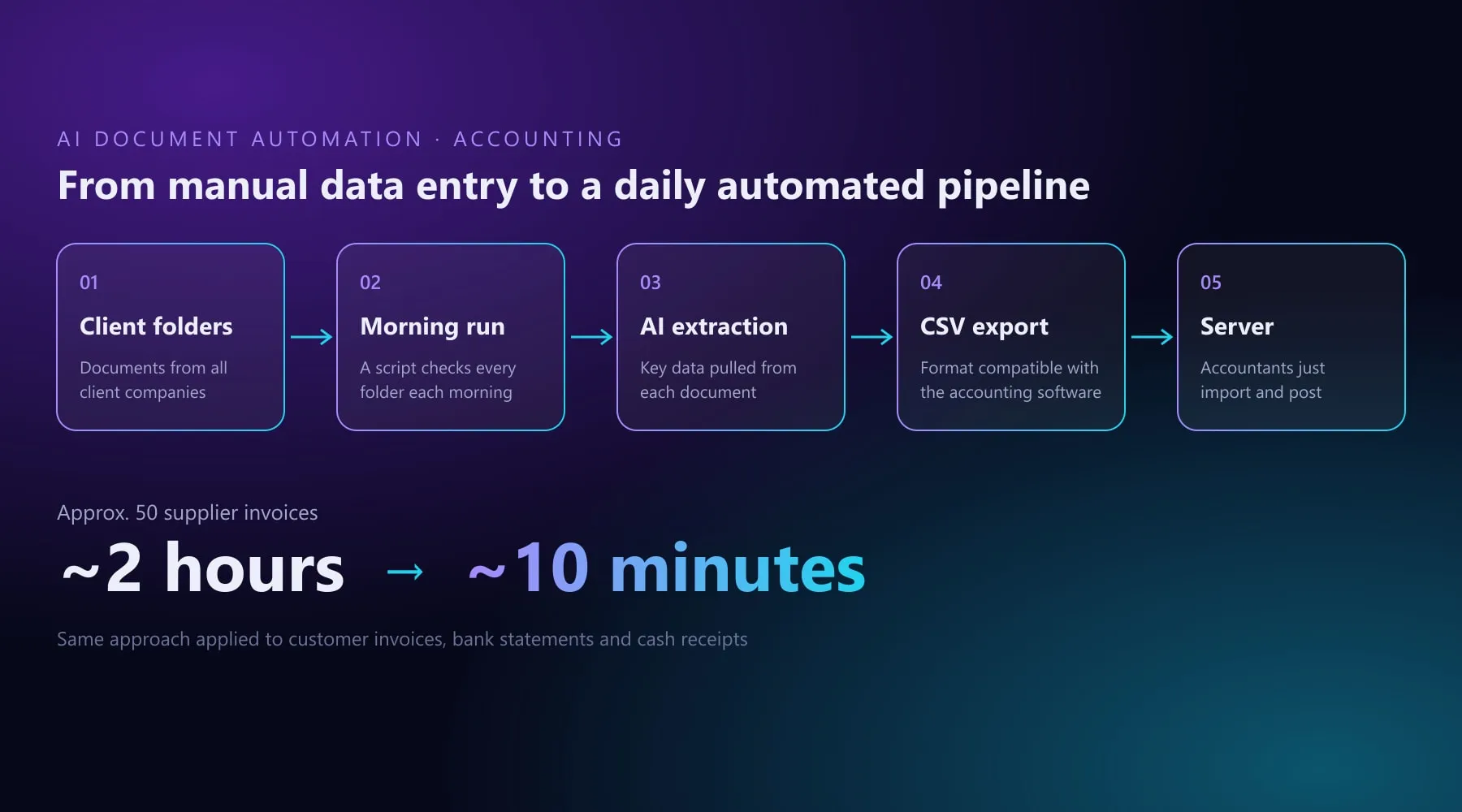
Next, together with the IT team, we turned it into a daily routine. Every morning, a script goes through the folders of all our client companies, finds new documents, extracts the required data and saves the import files to the server. The accountants simply import the files into the accounting software, and the documents are recorded.
Once the approach worked for supplier invoices, we applied it to customer invoices, bank statements and cash receipts.
The project started at the beginning of 2026 with ChatGPT and NotebookLM. In June we moved to Claude and Claude Code, which allowed us to build a more comprehensive solution.
Final outcome
Processing a batch of around 50 supplier invoices went from roughly 2 hours of manual work to about 10 minutes. The same pipeline now also covers customer invoices, bank statements and cash receipts.
Key takeaways
- The best automation ideas come from looking closely at what people repeat every day.
- Start with one document type, prove it works, then scale the same approach to others.